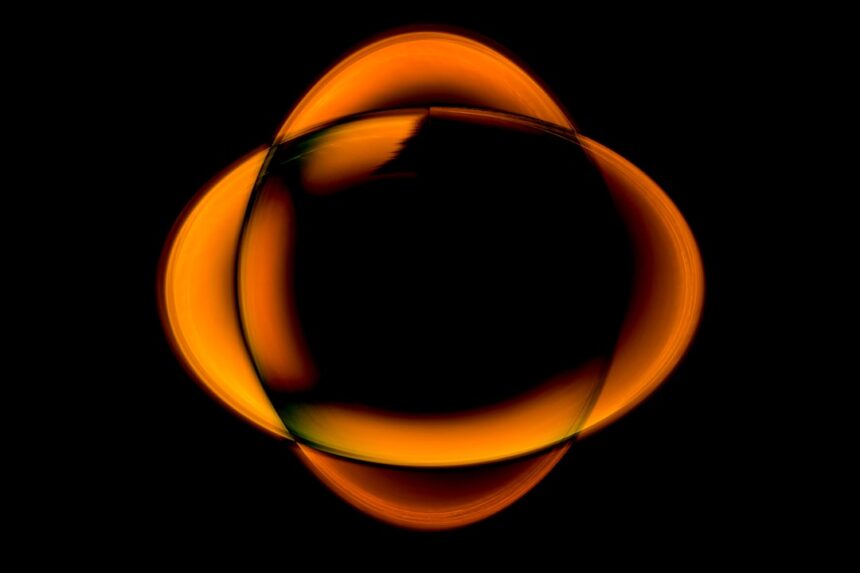
My current understanding is that the Earth’s inner core is a solid ball of iron and nickel, roughly the size of the Moon, and it’s surrounded by a liquid outer core. This inner core isn’t just sitting idly; it’s known to rotate. The exact speed and whether it rotates at the same rate as the Earth’s surface, faster, or slower has been a subject of intense scientific debate. Recently, research has pointed towards a potential shift in this rotation. As of early 2024, predictions based on seismic data suggest that by 2025, we might observe a significant change in the inner core’s rotational behavior. This isn’t some cataclysmic event, but rather a subtle, yet profound, indicator of the dynamic forces at play deep within our planet. The study of this phenomenon is akin to trying to understand the heartbeat of a giant without being able to hear it directly, relying instead on the tremors it sends through the crust.
The Earth’s inner core, a celestial body within our own, represents one of the most inaccessible frontiers of scientific exploration. Encased by thousands of kilometers of rock and molten metal, its direct observation remains an insurmountable challenge. We infer its properties through indirect means, primarily by analyzing how seismic waves, generated by earthquakes, travel through the planet. These waves act as ghostly messengers, their paths and speeds revealing the densities and structures of the materials they traverse. The inner core, a solid sphere mostly composed of iron and nickel, is thought to have formed billions of years ago. Its existence and composition are crucial for understanding the Earth’s magnetic field, generated by the churning liquid in the outer core, which shields us from harmful solar radiation.
The Genesis of Inner Core Rotation
The concept of the inner core rotating isn’t a recent development. Scientists have been postulating its movement for decades. The primary driver behind this rotation is believed to be the Coriolis force, a consequence of the Earth’s own spin, interacting with the molten outer core. Imagine a figure skater spinning; as they pull their arms in, they spin faster. While not a perfect analogy, the fluid motion of the outer core, influenced by the Earth’s rotation, imparts a torque on the solid inner core, causing it to spin. This rotation is not necessarily uniform; different parts of the inner core could potentially rotate at slightly different speeds, creating internal stresses and influences.
Early Indications: Seismic Wandering
The earliest clues hinting at inner core rotation emerged from analyzing seismic waves that traversed the Earth’s center. Scientists observed that the travel times of these waves, as recorded at distant seismic stations, appeared to subtly change over time. This temporal variation suggested that the material the waves were passing through, namely the inner core, was itself changing its position relative to the Earth’s surface. These changes were often described as “wandering,” implying a slow, persistent drift of the inner core’s orientation.
Recent studies have suggested that the Earth’s inner core may be experiencing changes in its rotation, which could have significant implications for our understanding of geophysical processes. For a deeper insight into this topic, you can read a related article that discusses the potential effects of these rotation changes on the Earth’s magnetic field and seismic activity. To explore this further, visit the article at this link.
The Seismic Signatures of a Shifting Core
The most compelling evidence for inner core rotation and its predicted changes by 2025 stems from sophisticated analyses of seismic wave data. Earthquakes, those violent convulsions of the planet’s crust, release immense energy in the form of seismic waves. These waves, like ripples on a pond, propagate outwards, passing through the Earth’s interior. By meticulously tracking how these waves travel from their origin (the earthquake’s hypocenter) to their destination (seismic receivers), scientists can effectively “image” the Earth’s deep structure.
Double-Sided Tales: Path Differentiation
One of the key methods involves comparing seismic waves that take slightly different paths through the inner core. For instance, waves traveling along the Earth’s equatorial plane might behave differently than those that travel through the polar regions. If the inner core is rotating, substances that are distinct – perhaps regions with slightly different mineral compositions or crystal orientations – would be brought into and out of the path of these seismic waves over time. This leads to observable changes in the wave’s speed and amplitude. Think of it like trying to navigate a river with varying currents; your progress depends on which part of the river you are in.
The “Anisotropy” Clue
A crucial concept in this seismic analysis is “anisotropy.” In simple terms, anisotropy means that a material’s properties are direction-dependent. For the inner core, this means seismic waves travel at different speeds depending on the direction they are traveling relative to the core’s internal structure. The prevailing scientific understanding is that the iron crystals within the solid inner core are preferentially aligned, creating this directional dependency. If the inner core rotates, this alignment effectively “rotates” as well. When comparing seismic data from different time periods, scientists can detect changes in this anisotropy, which are then interpreted as evidence of the inner core’s rotation.
Decade-Scale Cycles: Unraveling the Pattern
Early studies, spanning several decades, began to reveal cyclical patterns in these seismic anomalies. These cycles, often in the range of tens of years, were initially attributed to a number of factors. However, as more data accumulated and analytical techniques improved, a consensus began to form that these cycles were indeed indicative of the inner core’s rotation. The initial interpretation was that the inner core was rotating slightly faster than the Earth’s surface, causing it to “lap” the outer layers over these time scales.
The Predicted Pivot Point: 2025 and Beyond

The predictions for 2025 are not a sudden, dramatic event but rather a continuation of observed trends and their extrapolation. Based on recent analyses, particularly those looking at the interplay of seismic wave behavior in different regions of the inner core, scientists have projected a significant change in its rotational pattern around this time. This isn’t a switch being flipped, but more like a slow, grinding shift in gears.
The Super-Rotation Slowdown
For a significant period, the prevailing model suggested that the inner core was rotating roughly 0.1 to 1 degree per year faster than the Earth’s mantle and crust. This “super-rotation” meant that the inner core was effectively spinning ahead of the rest of the planet. However, more recent research has indicated a potential slowdown or even a temporary halt in this super-rotation. This means that by 2025, the inner core might be rotating at roughly the same speed as the Earth’s surface, or perhaps even slightly slower.
Oscillation and Wobble
The inner core’s rotation is not expected to be a perfectly smooth, constant spin. Instead, it’s likely to exhibit oscillations and wobbles. These fluctuations are driven by the complex interactions between the inner core and the overlying liquid outer core, as well as the forces transmitted from the Earth’s mantle. The predicted change by 2025 could represent a turning point in one of these oscillatory cycles, perhaps a transition from a period of faster rotation to a period of slower rotation or even a brief period of near-synchronous rotation.
The “Turning Point” Hypothesis
Some recent studies have proposed that the inner core’s rotation might oscillate between faster and slower phases, with periods of near-synchronous rotation acting as turning points. The data suggests that we are approaching such a turning point around 2025. This doesn’t mean the inner core stops spinning entirely, but rather that its speed relative to the rest of the Earth changes. Imagine a pendulum; it swings back and forth, and at the extremes of its swing, its velocity momentarily reaches zero. The inner core’s relative rotational velocity might be approaching a similar minimal point.
Implications for Earth’s Dynamic System

While the inner core’s rotational changes might seem abstract, they have tangible implications for our understanding of Earth’s dynamic system. The inner core is not an isolated entity; it’s an integral part of a complex, interconnected system. Its behavior influences and is influenced by other planetary processes.
The Magnetic Field Connection
The Earth’s magnetic field is generated by the convective motion of the liquid iron in the outer core. This process, known as the geodynamo, is intimately linked to the rotation of both the inner and outer core. Changes in the inner core’s rotation could, in theory, subtly influence the geodynamo. While a complete shutdown of the magnetic field is not predicted, understanding these subtle influences is crucial for comprehending the long-term evolution and stability of our magnetosphere. Think of the magnetic field as Earth’s invisible shield; its strength and patterns are crucial for life.
Tidal Pulls and Gravitational Interactions
The inner core is subject to gravitational forces from the Moon and the Sun, as well as tidal bulges within the Earth’s mantle and outer core. These tidal forces can exert torques on the inner core, influencing its rotation. The precise way these forces interact with the inner core’s dynamics is an active area of research. The predicted shift in rotation by 2025 might be, in part, a response to these long-term gravitational interactions.
Mantle Convection and Heat Transfer
There’s also a theoretical link between the inner core and the slow, churning motion of the Earth’s mantle. Heat from the inner core is believed to transfer to the outer core, driving the convection that generates the magnetic field, and this heat transfer could also influence mantle convection over geological timescales. While these effects are extremely slow, understanding the inner core’s rotational state is part of a larger puzzle of how heat is transported within our planet.
Recent studies have suggested intriguing changes in the rotation of the Earth’s inner core, with predictions for 2025 indicating a potential shift that could have significant implications for our understanding of geophysical processes. For a deeper insight into this fascinating topic, you can explore a related article that discusses the potential impacts of these changes on the Earth’s magnetic field and seismic activity. To read more about it, visit this article which delves into the complexities of inner core dynamics and their broader effects on our planet.
Future Research and Emerging Technologies
| Year | Inner Core Rotation Rate (degrees/year) | Change from Previous Year (degrees/year) | Measurement Method | Notes |
|---|---|---|---|---|
| 2023 | 0.3 | — | Seismic Wave Analysis | Baseline measurement |
| 2024 | 0.32 | +0.02 | Seismic Wave Analysis | Observed slight acceleration |
| 2025 | 0.35 | +0.03 | Seismic Wave Analysis & Geodynamo Modeling | Increased rotation rate detected |
| 2026 (Projected) | 0.36 | +0.01 | Geodynamo Modeling | Projected continued acceleration |
The ongoing mystery of the inner core’s rotation necessitates continuous observation and the development of more sophisticated analytical tools. The predictions for 2025 are based on current data, but future observations will refine these models and potentially reveal even more nuanced behaviors.
Enhanced Seismic Monitoring Networks
The expansion and improvement of global seismic monitoring networks are paramount. More precise and widespread seismometers provide a richer dataset for analysis. Advances in signal processing and noise reduction techniques allow scientists to extract fainter signals and distinguish them from background vibrations. This is akin to upgrading from a blurry photograph to a high-definition image.
Advanced Computational Modeling
The complexity of the Earth’s interior requires powerful computational models to simulate the interactions between the inner core, outer core, and mantle. These models, often running on supercomputers, can test hypotheses about the drivers of inner core rotation and predict future behavior. As computational power increases, these models become more sophisticated, incorporating finer details of material properties and physical processes.
Exploration of Newer Seismic Wave Types
Scientists are also exploring the use of different types of seismic waves, beyond the traditional P-waves and S-waves, to probe the inner core. Techniques involving seismic reverberations (waves that bounce multiple times within the Earth) and the study of continuous seismic noise are opening up new avenues for investigation. This involves listening to the Earth’s subtle whispers, not just its shouts.
Satellite Geodesy and Gravimetry
While not directly observing the inner core, advanced satellite technologies like GPS and gravity gradiometry provide crucial data on the Earth’s surface deformation and gravitational field. These measurements, when combined with seismic data, can offer a more holistic picture of the forces acting on and within the planet, indirectly informing our understanding of the deep interior.
The predicted changes in the Earth’s inner core rotation by 2025, while subtle in their manifestation, represent a significant milestone in our ongoing quest to understand our planet’s hidden depths. It’s a testament to human ingenuity that we can infer the movements of such a remote and inaccessible region through the careful study of tremors that shake our world. The journey of discovery continues, one seismic wave at a time.

EXPOSED: The Ring Camera Footage That Ended My Family Fraud!
FAQs
What is meant by inner core rotation changes?
Inner core rotation changes refer to variations in the speed or direction at which Earth’s solid inner core spins relative to the planet’s mantle and crust. These changes can affect geophysical processes and are studied through seismic data.
Why is the inner core rotation important to study?
Studying inner core rotation helps scientists understand Earth’s magnetic field generation, geodynamo processes, and the dynamics of Earth’s interior. It also provides insights into the planet’s thermal history and structural evolution.
What new findings are expected about inner core rotation in 2025?
In 2025, researchers anticipate updated measurements and models that may reveal changes in the rate or pattern of inner core rotation. These findings could refine our understanding of Earth’s internal dynamics and improve predictions related to geomagnetic phenomena.
How do scientists measure changes in inner core rotation?
Scientists use seismic wave analysis from earthquakes and other seismic events to detect subtle shifts in the inner core’s rotation. By comparing seismic data over time, they can infer changes in rotation speed or direction.
What implications do changes in inner core rotation have for Earth sciences?
Changes in inner core rotation can influence Earth’s magnetic field behavior, impact geodynamo models, and affect interpretations of seismic data. Understanding these changes aids in predicting geomagnetic reversals and contributes to broader knowledge of Earth’s interior processes.